Author: Raymond Newman, PhD

  • I Wonder If They Feel It Too

    I Wonder If They Feel It Too

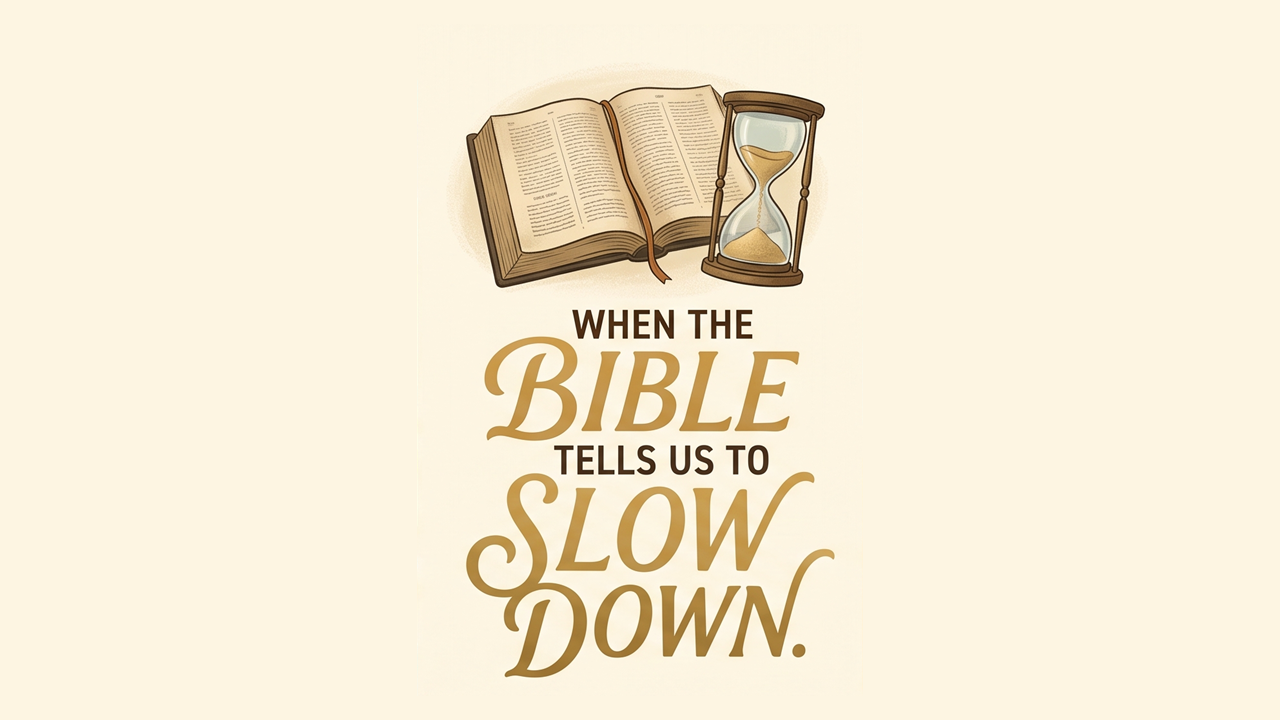
  • When the Bible Tells Us to Slow Down

    When the Bible Tells Us to Slow Down

    The Bible is wonderfully honest about the care its difficult passages demand: Scripture can be misunderstood, so faithful reading requires patience, context, and humility.

    The Bible does not pretend that everything in it is easy to understand.

    Peter says so himself.

    Near the end of his second letter, Peter speaks about Paul and his letters. He acknowledges that Paul writes about things that can be difficult to understand—and then adds a sobering warning:


    “There are some things in them hard to understand, which the ignorant and unstable twist to their own destruction, as they do the other scriptures.”
    —2 Peter 3:16, RSV-CE


    That is quite a statement.

    Peter does not say that Paul’s letters are impossible to understand. He says some things are hard to understand. And he warns us that Scripture can be twisted when it is handled carelessly.

    That ought to make us slow down.

    We live in a world of quick answers. Someone posts a Bible verse online, and within seconds another person has explained exactly what it means. A verse is pulled from a chapter and a chapter from a book; before long, an entire theology rests on a sentence that may never have been intended to stand alone.

    But Scripture deserves better than that.

    Peter’s warning gives us the posture: humility. Paul’s background shows us the method: read an author within the world that formed his language, arguments, and assumptions.

    Consider Paul

    The New Testament tells us something important about the man whose letters make up so much of it: Paul was a Pharisee.

    Acts tells us that Paul identified himself as a Pharisee. In his letter to the Philippians, Paul describes himself as a Hebrew of Hebrews and says that “as to the law” he was a Pharisee. In Galatians, Paul describes his former life in Judaism and his extraordinary zeal for the traditions of his ancestors.

    These details matter.

    They matter because Paul did not wake up one morning and become a Christian theologian with no background. He was formed within Judaism. He knew the Scriptures of Israel. He knew the Law. He knew the traditions. He knew the arguments. He knew how his fellow Jews understood the covenant, the promises, the Messiah, and the Law.

    Then Paul encountered the risen Christ, and everything changed—but his Jewish formation did not disappear. It became part of the way he understood and proclaimed Christ.

    When we read Paul, then, we need to read him as Paul—not as a twenty-first-century American Protestant, Catholic, evangelical, secular philosopher, or social-media commentator. We need to hear the apostle in his own world.

    That is harder work.

    And that is precisely the point.

    When Paul writes about the Law, grace, faith, justification, Abraham, circumcision, the flesh, the Spirit, the covenant, or the promises of God, we cannot simply assume that those words carry exactly the same meaning they carry in our modern conversations.

    Paul is arguing with ideas.

    He is answering questions.

    He is addressing real communities with real problems.

    And he is doing all of this as a Jewish Pharisee who has come to believe that Jesus is the Messiah, the Son of God, and the fulfillment of God’s promises.

    Context matters.

    History matters.

    Language matters.

    The whole of Scripture matters.

    And, perhaps most importantly, the Church’s way of reading Scripture matters.

    This is why I have become increasingly convinced that Catholics need to learn not simply to read the Bible, but to read it well.

    Peter’s warning should make us humble.

    The danger is not merely that we might misunderstand a difficult passage, but that we might do so with absolute confidence.

    That is a dangerous combination.

    A person can take a perfectly true sentence from Scripture and use it to communicate something Scripture never intended to say.

    That is how biblical arguments become endless.

    One person has a verse.

    Another person has another verse.

    Both insist, “The Bible says…”

    And sometimes both have failed to ask the more important question:

    What is the Bible actually saying here?

    Reading Scripture well requires patience.

    It requires us to read the verse in its paragraph, the paragraph in its chapter, the chapter in its book, and the book within the whole story of Scripture.

    And Catholics believe that this whole story has a living context: the community in which Scripture was received, preserved, proclaimed, and interpreted—the Church.

    So slow down in three ways:

    These habits do not weaken confidence in the Bible; they discipline that confidence with reverence.

    This does not mean Catholics are afraid of the Bible.

    Quite the opposite.

    It means we take the Bible seriously enough to approach it carefully.

    We do not need to be frightened by difficult passages. We need to be humble before them.

    Peter had walked with Jesus.

    Peter was an apostle.

    Peter knew Paul.

    And Peter still said that some things Paul wrote were hard to understand.

    Maybe we should listen to him.

    Maybe the next time we encounter a difficult passage of Scripture, instead of immediately asking, “How can I use this verse to prove my point?” we should ask:

    Sometimes the most faithful thing we can do with Scripture is slow down, because the Bible is not ammunition for winning arguments. It is the Word of God, and if we truly believe that, we ought to handle it with reverence.

    Peter’s warning is not an invitation to stay away from difficult passages.

    It is an invitation to approach them with humility.


    Read deeply. Read carefully. Read the whole story. And never be ashamed to admit that sometimes Scripture requires us to slow down before we speak.
  • The Hour Between

    The Hour Between

    A Nocturne of Trust and Betrayal

    The diner sat on the corner of nothing and nowhere, the kind of place that only truly exists in the hour between one day and the next, when the regular world has gone home to sleep. Mabel’s, the old red-and-blue neon sign said, though nobody living recalled a Mabel. The place had been built when chrome was meant to gleam and coffee cost a dime, and no one had bothered to teach it a newer decade. Outside, the rain came down in long silver threads, catching the neon and breaking it into pools of color on the wet asphalt, like something spilled and forgotten.

    Inside, a man named Walt sat at the long Formica counter on a red vinyl stool, a cup of coffee gone cold an hour past caring between his hands. His fedora rested on the stool beside him, its felt darkened at the brim where years of rain and nervous fingers had worn it smooth. Behind the counter, a row of chrome napkin holders and glass sugar pourers caught the weak light. He wasn’t waiting on anybody. Wasn’t running from anybody either, though it might have looked that way to a stranger passing by — a man alone at 3 AM in a diner has that look about him, guilty of some crime he never committed.

    The cook had gone in the back, past the swinging door with its round porthole window. The waitress, a tired young thing named Dot, had propped herself against the far wall beneath a yellowed Coca-Cola clock, her eyes half shut, not sleeping so much as resting somewhere just this side of it. The Wurlitzer in the corner, all curved glass and chrome ribs, had quit an hour ago and nobody had fed it another quarter. A tabletop selector still offered songs by names half rubbed away, but its little numbered buttons had long since stopped working. And so the diner had fallen into an uncanny and total quiet, broken only by the rain drumming soft on the tin awning outside and the faraway sigh of a truck somewhere out on the interstate, going wherever trucks go at that hour.

    Walt looked at his hands wrapped around that cold cup, and for the first time in longer than he could rightly say, his mind wasn’t running its usual circuit — the bills, the ex-wife, the boy who wouldn’t call him back, the ache in his lower back that never seemed to leave. Beneath all that was the fresher hurt: someone he had trusted had taken what he had offered in confidence and used it against him. The betrayal had left him ashamed of having believed, as though trust were the foolishness and not the breaking of it. The fedora had belonged to his father, who had bought it with his first week’s pay and left it to Walt without ceremony, hanging on the same hallway peg where it had waited every evening of his boyhood. Walt had worn it out of habit at first, then grief, and finally for reasons he no longer tried to name.

    In his mind the phone rang again. He heard the familiar voice soften before it delivered the words, the way a hand might settle gently on a shoulder before steering a man toward a door. Walt had kept listening long after the meaning was plain, waiting for some correction, some small mercy hidden at the end. None came. What troubled him now was not only what had been done, but how quickly every old kindness had begun to look counterfeit. He searched their years together for the moment trust had turned without his seeing it: a pause held too long, a question answered too carefully, a confidence received with lowered eyes. He knew memory could become a crooked witness when hurt was calling the questions, yet he could not stop putting the past on trial. If he threw out every good thing because of one betrayal, he thought, then the betrayal would take more than it had already taken. But if he kept believing in those good things, did that make him faithful—or merely foolish?

    He watched the neon bleed red across the wet street, watched it shiver every time a raindrop broke the puddle’s skin. Beyond the glass, his Cadillac waited beneath the sign, low and long, its enormous tailfins rising out of the rain like the wings of some grounded thing. He had waxed it that afternoon, before the phone call, and the water still beaded across its dark hood and roof in perfect bright pearls, each one catching a fleck of neon before slipping away. Looking at it, Walt thought: this was the hour between — between the wound and whatever came after it, between the life he had trusted and the life he would have to make from what remained. Nothing was asking him to forgive before he was ready. Nothing wanted the hurt explained away or made useful. The world outside kept right on turning — somewhere a baby was being born, somewhere a man was dying, somewhere sirens were crying down some highway he’d never drive — but none of it could touch him in here, in this small warm box of light standing against the dark and the rain. For now, it was enough that the hurt could sit beside him without pretending to be anything else.

    Dot stirred, rubbed one eye, and said without looking over, “Refill?”

    “No,” Walt said. Then, after a moment, “Dot, you ever find out somebody wasn’t who you thought they were?”

    Dot opened her eyes and looked at him across the counter. “Once or twice.”

    “Trouble is,” Walt said, turning the cup a quarter turn between his palms, “I can’t decide whether knowing means I was wrong about everything before it.”

    “Maybe it only means you’re right about them now.”

    Walt watched a bead of rain gather on the Cadillac’s hood until it grew too heavy and ran. “If I trust nobody after this, they win,” he said. “If I trust again, maybe I’m asking for it.”

    Dot reached for the coffee pot but did not pour. “Being careful isn’t the same as being closed,” she said.

    Walt’s first impulse was to dismiss it as the kind of wisdom that fit neatly across a counter and nowhere else. His mouth tightened, and his thumb found the worn brim of his father’s fedora. But Dot had already turned away, leaving the words with him instead of pressing them home. He drew a slow breath. Something in his chest loosened—not forgiveness, not yet, but a little room around the hurt. Through the window, another bead of rain slid from the Cadillac without leaving a mark. Walt set his cup down and nodded once, more to himself than to her.

    “I believe I’ll sit here a while longer,” he said.

    And he did, watching the rain, letting the hour between what had been and what would be hold him the way a mother holds a child too tired to know it’s being carried.

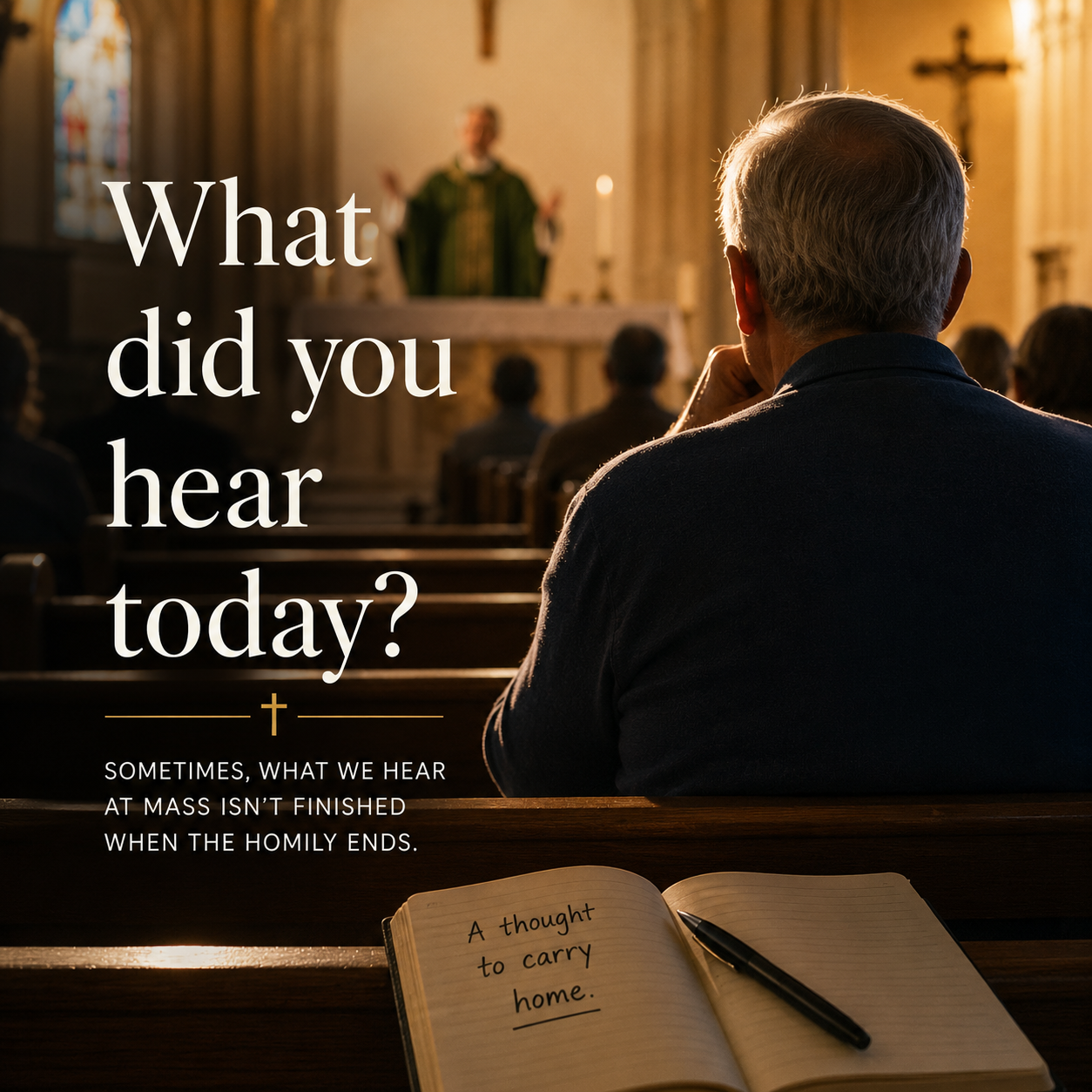
  • What did you hear today?

    What did you hear today?

    Sometimes, during a homily, the priest will say something that stops me in my tracks.

    I’ll find myself thinking, Wait a minute… is he talking to me?

    Not because he knows anything about what is going on in my life, but because somehow the words land exactly where they need to land.

    After Mass, we visit with one another. We talk about our families, the weather, what we’re having for lunch, and whatever else happens to come up. But I wonder how often we ask each other, “So, what did you think about Father’s homily today?”

    I used to have a friend I could talk to about those things. We would sometimes discuss the readings and the homily afterward. It was never about critiquing the priest. We were simply trying to understand what we had heard and what God might be saying to us through it.

    His health is waning now, and he can’t get to Mass very often anymore.

    So these days, I find myself pondering the homily alone.

    Maybe that’s one reason I occasionally write about something I heard at Mass. About once a week or so, a particular thought will stay with me long after I’ve left the church. I write about it because I haven’t quite finished thinking about it.

    Every now and then, a homily stays with you for years. I can still remember one I heard several years ago. The priest explained a particular passage of Scripture in a way that suddenly made sense to me. It was one of those moments when you think, How have I never seen that before?

    Those moments are gifts.

    And perhaps that’s what a good homily is meant to do. Not simply give us something to hear for fifteen minutes, but give us something to carry home.

    Maybe we ought to talk about those things a little more.

    Not to judge the homily.

    Not to judge the priest.

    Just to ask one another:

    “What did you hear today?”

    Because sometimes, what we hear at Mass isn’t finished when the homily ends.

    Raymond Newman
    Ex Scintilla Incendium
    ✨ From a spark, a fire 🔥

  • The Elf Who Came with Lemonade

    The Elf Who Came with Lemonade

    Nobody in the house could rightly say when he arrived. There was no knock at the door, no crunch of tires in the drive, no dog barking at a stranger in the yard. He just was, the way frost is on a windshield some mornings and wasn’t the night before. The first anybody knew of him was a Tuesday, or maybe it was a Wednesday, one of the weekends the grandchildren were staying over, when the littlest of them padded into the kitchen in sock feet looking for breakfast and found instead a pitcher of lemonade sweating on the middle shelf of the refrigerator, cold and yellow as a slice of morning sun, and up on top of the cabinets, legs crossed and hands folded in his lap like he’d been carved there, sat the elf.
    Grandma and Grandpa had raised their own children on a fair hand of rules and a firm bedtime, the way you do when the whole weight of raising somebody up right sits square on your shoulders. But grandchildren are a different arithmetic altogether. There’s no weight to carry, only the visit itself, short and sweet and gone too soon, and so a grandparent’s heart tends to lean toward yes before it ever gets around to asking why not. Which is maybe why, of all the houses an elf might’ve picked to sit still in, he’d gone and chosen theirs — a house already halfway inclined toward spoiling somebody rotten, just looking for an excuse.
    He was a small fellow, no bigger than a loaf of bread, dressed in green wool gone soft with age, and he had the particular stillness of a thing that has decided not to move while anyone’s looking. He never said a word. Not one. Some folks in that house took to wondering if he could talk at all, or if he’d simply made up his mind, long before he came to sit on that shelf, that talking was more trouble than it was worth. Either way, he kept his own counsel and he kept it well.
    What he did instead of talking was work, quiet as a held breath, in the hours when the house had gone dark and the furnace ticked and settled and everybody was dreaming their separate dreams. Nobody ever caught him at it. That was the strange and lovely part. You’d go to bed with the kitchen looking the way a kitchen looks at the end of an ordinary day, dishes rinsed, counters wiped, nothing out of the usual, and you’d wake to find the world had been tended to while your back was turned.
    The lemonade was just the start of it. There’d be mornings the good glasses, the ones saved for company, would be lined up on the table like they were waiting for a party nobody’d been told about. Other mornings there might be a plate of something sliced just right, or the fireplace already laid with kindling stacked the way only a patient hand stacks it, waiting on a match. Once, after a week of hard rain, everybody came down to find every pair of boots by the door stuffed with newspaper and drying by the vents, and not a soul could explain it except to look up at that shelf, where the elf sat same as ever, giving away nothing, his painted eyes fixed on some middle distance like he was thinking on matters far above lemonade and dish towels.
    The grandchildren took to leaving him things in return, on account of it seeming rude not to. A drawing folded small. A single peppermint set beside his foot, sometimes two, because Grandma had a habit of looking the other way when candy went missing from the dish. Once, a note that only said THANK YOU in big crooked letters, because they figured if he couldn’t speak, maybe writing was worth a try. The elf never let on whether he’d read it. He was awful good at never letting on.
    There was talk, of course, about where such a fellow might have come from, and why a house such as theirs, with nothing special to recommend it, should be the one he’d chosen to sit still in. Grandpa smiled the smile a man smiles when he’s decided a mystery is better left a mystery, and Grandma smiled the smile of a woman who half suspected her husband knew a good deal more about that elf than he was letting on and had decided not to press it. The grandchildren had their own theories, each stranger and kinder than the last, and they argued them at supper the way other families argued about baseball, while Grandma quietly refilled everybody’s glass whether it needed refilling or not.
    What nobody argued about was this: the lemonade kept coming, sweet and cold, and the little quiet kindnesses kept piling up in corners of the house like snow drifting in against a fence, gentle and without any fuss about it. And every morning, there he sat on his shelf, green and small and silent, keeping whatever secret it is that elves keep, while the whole house woke up around him grateful, and none the wiser, and glad enough for that. And maybe, Grandma thought more than once, watching the grandchildren argue their theories over pancakes while Grandpa pretended not to smile behind his coffee cup, that was the whole trick of grandparenting and elf-keeping both — not needing to know the how of a good thing, only being glad enough to let it happen, and happy to spoil somebody a little more on account of it.

    — Raymond Newman
    Ex Scintilla Incendium
    From a spark, a fire🔥

  • Two Silences

    Two Silences

    There are two Latin phrases that have been rattling around in my head lately.

    Sacrum Silentium.

    Sacred Silence.

    I know that silence well. It is the quiet that comes after Communion, when the singing has ended and the congregation settles back into its seats.

    For a few moments, nobody needs anything from me.

    There is no place I need to go. Nothing I need to accomplish. No clever thought I need to have.

    Just silence.

    And Christ.

    Then there is another phrase:

    Silentium Magnum.

    The Grand Silence.

    I won’t tell you where I learned that phrase. Some things are better left where they belong.

    But the words themselves have stayed with me.

    The Grand Silence.

    It sounds larger than ordinary silence. Not merely the absence of talking, but the kind of silence that makes you aware of how much noise you normally carry around with you.

    We are not very good at silence anymore.

    If the room gets quiet, we reach for our phones. If the car is quiet, we turn on the radio. If our minds get quiet, we find something else to think about.

    We seem to believe that silence is an empty space that needs to be filled.

    But perhaps silence isn’t empty at all.

    Perhaps it is a place.

    A place where we can sit for a while without trying to fix anything.

    A place where we can listen.

    A place where God doesn’t have to compete with us.

    I wonder if that is why the silence after Communion has always seemed different to me.

    It isn’t an interruption in the Mass.

    It is part of the Mass.

    The words have been spoken. The bread has been broken. Christ has been received.

    And then comes silence.

    Sacred Silence.

    Maybe there are moments in life when we need something even greater.

    A Grand Silence.

    Not because God has stopped speaking, but because we have finally stopped talking long enough to listen.

    — RN

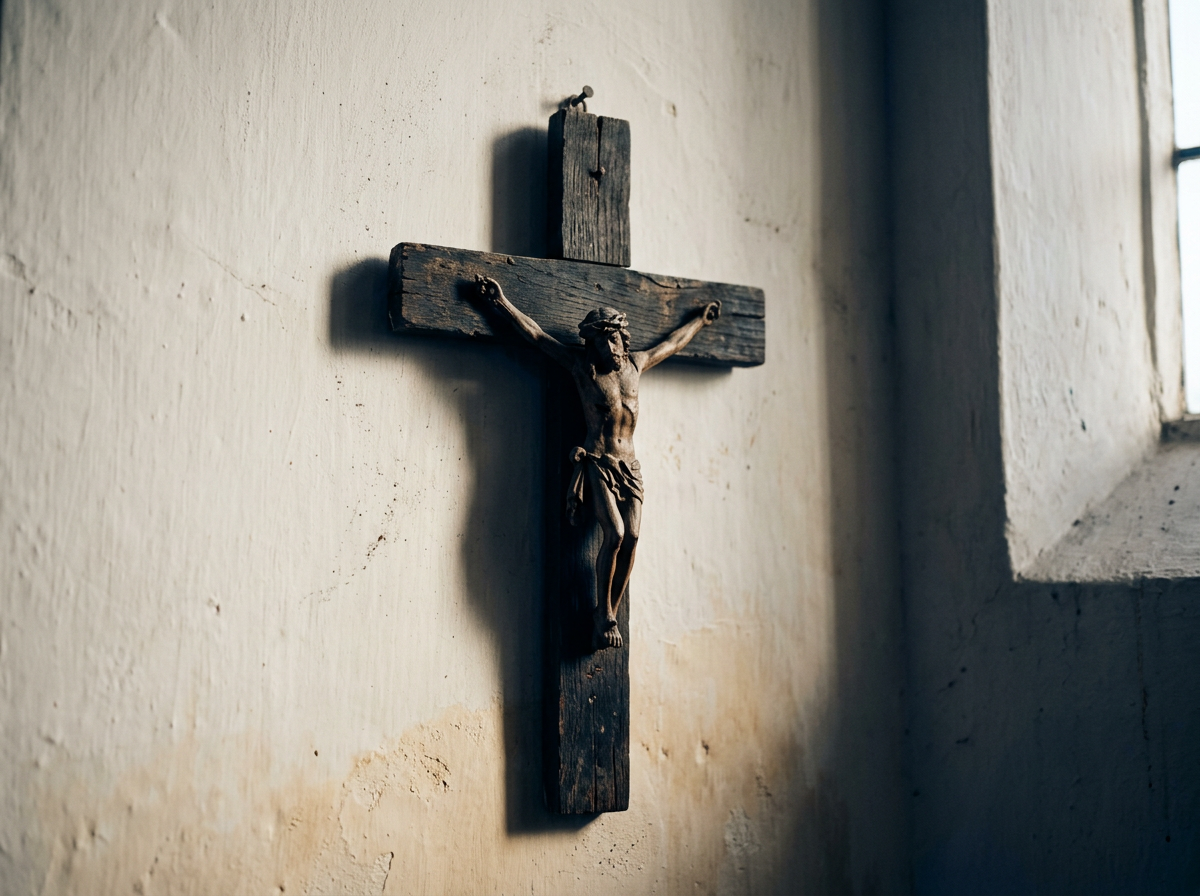
  • Christ Crucified

    Christ Crucified

  • System Test Failed Successfully

    System Test Failed Successfully

    If you are reading this, the blog launched without catching fire. That counts as a win.

    This was supposed to say “Hello World,” but that felt like showing up to a dinner party and announcing your name to the houseplants.

    So, hello. I started this space to think out loud, share what I’m reading and learning, and keep notes worth coming back to. More to come. Less placeholder.