A Nocturne of Trust and Betrayal
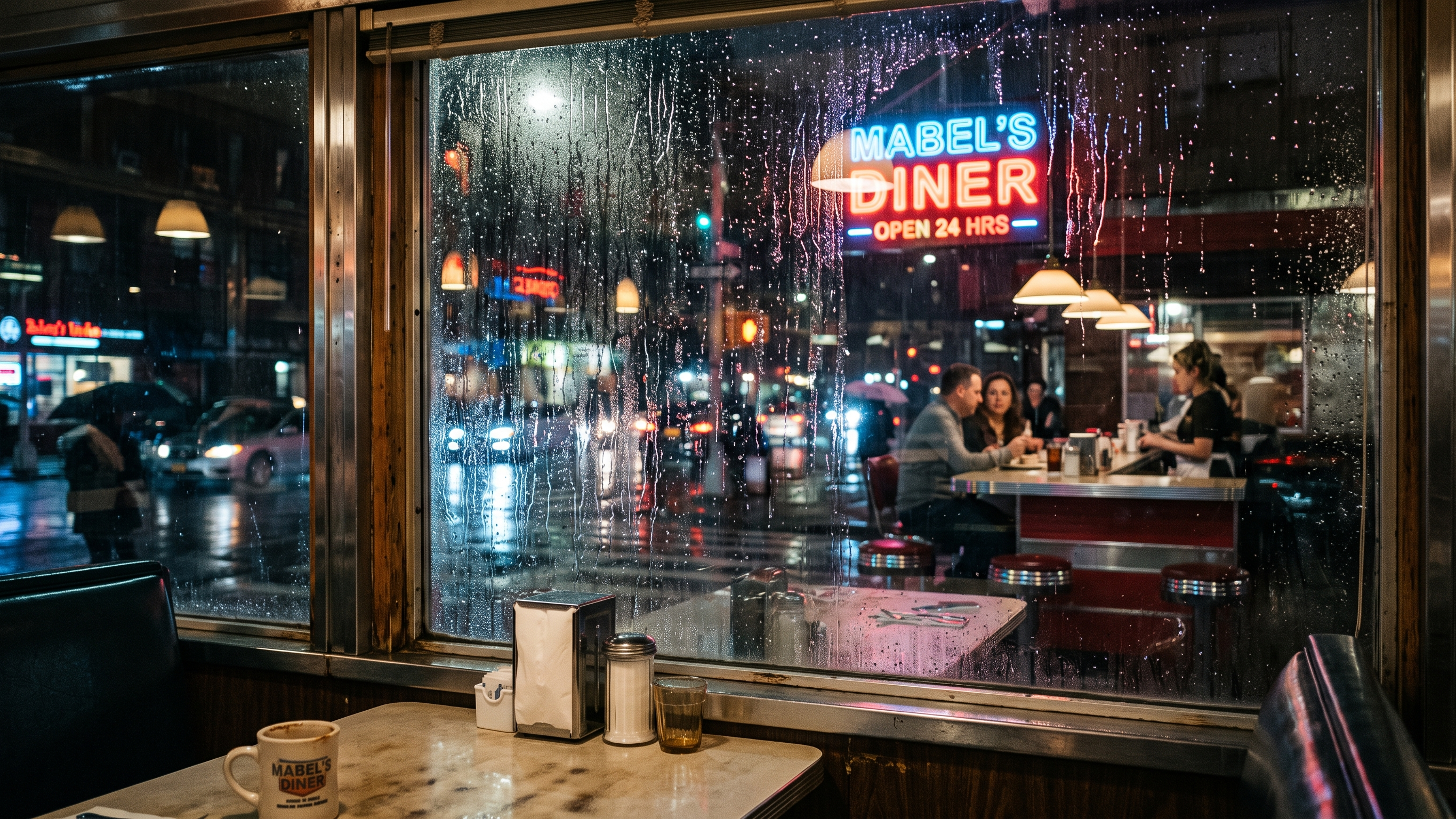
The diner sat on the corner of nothing and nowhere, the kind of place that only truly exists in the hour between one day and the next, when the regular world has gone home to sleep. Mabel’s, the old red-and-blue neon sign said, though nobody living recalled a Mabel. The place had been built when chrome was meant to gleam and coffee cost a dime, and no one had bothered to teach it a newer decade. Outside, the rain came down in long silver threads, catching the neon and breaking it into pools of color on the wet asphalt, like something spilled and forgotten.
Inside, a man named Walt sat at the long Formica counter on a red vinyl stool, a cup of coffee gone cold an hour past caring between his hands. His fedora rested on the stool beside him, its felt darkened at the brim where years of rain and nervous fingers had worn it smooth. Behind the counter, a row of chrome napkin holders and glass sugar pourers caught the weak light. He wasn’t waiting on anybody. Wasn’t running from anybody either, though it might have looked that way to a stranger passing by — a man alone at 3 AM in a diner has that look about him, guilty of some crime he never committed.
The cook had gone in the back, past the swinging door with its round porthole window. The waitress, a tired young thing named Dot, had propped herself against the far wall beneath a yellowed Coca-Cola clock, her eyes half shut, not sleeping so much as resting somewhere just this side of it. The Wurlitzer in the corner, all curved glass and chrome ribs, had quit an hour ago and nobody had fed it another quarter. A tabletop selector still offered songs by names half rubbed away, but its little numbered buttons had long since stopped working. And so the diner had fallen into an uncanny and total quiet, broken only by the rain drumming soft on the tin awning outside and the faraway sigh of a truck somewhere out on the interstate, going wherever trucks go at that hour.
Walt looked at his hands wrapped around that cold cup, and for the first time in longer than he could rightly say, his mind wasn’t running its usual circuit — the bills, the ex-wife, the boy who wouldn’t call him back, the ache in his lower back that never seemed to leave. Beneath all that was the fresher hurt: someone he had trusted had taken what he had offered in confidence and used it against him. The betrayal had left him ashamed of having believed, as though trust were the foolishness and not the breaking of it. The fedora had belonged to his father, who had bought it with his first week’s pay and left it to Walt without ceremony, hanging on the same hallway peg where it had waited every evening of his boyhood. Walt had worn it out of habit at first, then grief, and finally for reasons he no longer tried to name.
In his mind the phone rang again. He heard the familiar voice soften before it delivered the words, the way a hand might settle gently on a shoulder before steering a man toward a door. Walt had kept listening long after the meaning was plain, waiting for some correction, some small mercy hidden at the end. None came. What troubled him now was not only what had been done, but how quickly every old kindness had begun to look counterfeit. He searched their years together for the moment trust had turned without his seeing it: a pause held too long, a question answered too carefully, a confidence received with lowered eyes. He knew memory could become a crooked witness when hurt was calling the questions, yet he could not stop putting the past on trial. If he threw out every good thing because of one betrayal, he thought, then the betrayal would take more than it had already taken. But if he kept believing in those good things, did that make him faithful—or merely foolish?
He watched the neon bleed red across the wet street, watched it shiver every time a raindrop broke the puddle’s skin. Beyond the glass, his Cadillac waited beneath the sign, low and long, its enormous tailfins rising out of the rain like the wings of some grounded thing. He had waxed it that afternoon, before the phone call, and the water still beaded across its dark hood and roof in perfect bright pearls, each one catching a fleck of neon before slipping away. Looking at it, Walt thought: this was the hour between — between the wound and whatever came after it, between the life he had trusted and the life he would have to make from what remained. Nothing was asking him to forgive before he was ready. Nothing wanted the hurt explained away or made useful. The world outside kept right on turning — somewhere a baby was being born, somewhere a man was dying, somewhere sirens were crying down some highway he’d never drive — but none of it could touch him in here, in this small warm box of light standing against the dark and the rain. For now, it was enough that the hurt could sit beside him without pretending to be anything else.
Dot stirred, rubbed one eye, and said without looking over, “Refill?”
“No,” Walt said. Then, after a moment, “Dot, you ever find out somebody wasn’t who you thought they were?”
Dot opened her eyes and looked at him across the counter. “Once or twice.”
“Trouble is,” Walt said, turning the cup a quarter turn between his palms, “I can’t decide whether knowing means I was wrong about everything before it.”
“Maybe it only means you’re right about them now.”
Walt watched a bead of rain gather on the Cadillac’s hood until it grew too heavy and ran. “If I trust nobody after this, they win,” he said. “If I trust again, maybe I’m asking for it.”
Dot reached for the coffee pot but did not pour. “Being careful isn’t the same as being closed,” she said.
Walt’s first impulse was to dismiss it as the kind of wisdom that fit neatly across a counter and nowhere else. His mouth tightened, and his thumb found the worn brim of his father’s fedora. But Dot had already turned away, leaving the words with him instead of pressing them home. He drew a slow breath. Something in his chest loosened—not forgiveness, not yet, but a little room around the hurt. Through the window, another bead of rain slid from the Cadillac without leaving a mark. Walt set his cup down and nodded once, more to himself than to her.
“I believe I’ll sit here a while longer,” he said.
And he did, watching the rain, letting the hour between what had been and what would be hold him the way a mother holds a child too tired to know it’s being carried.
Leave a Reply